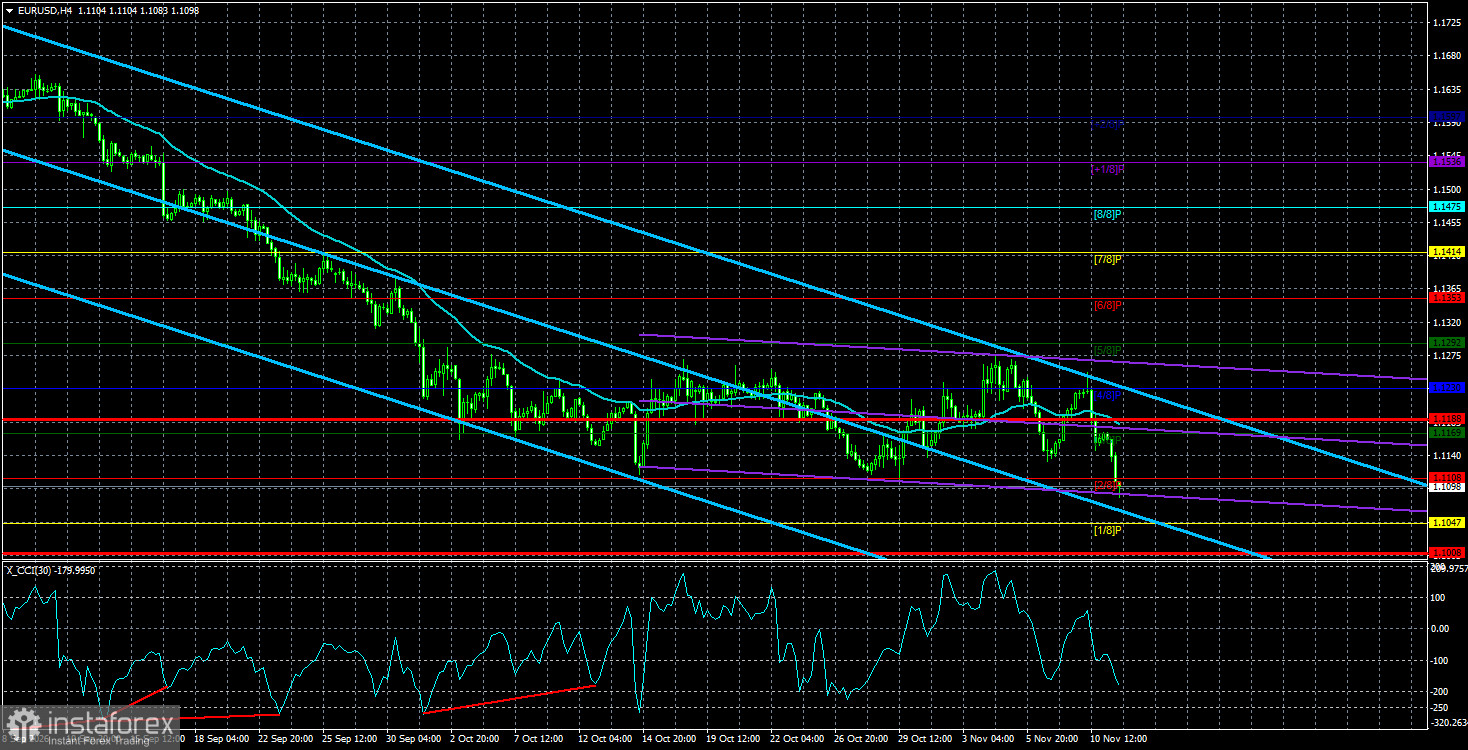
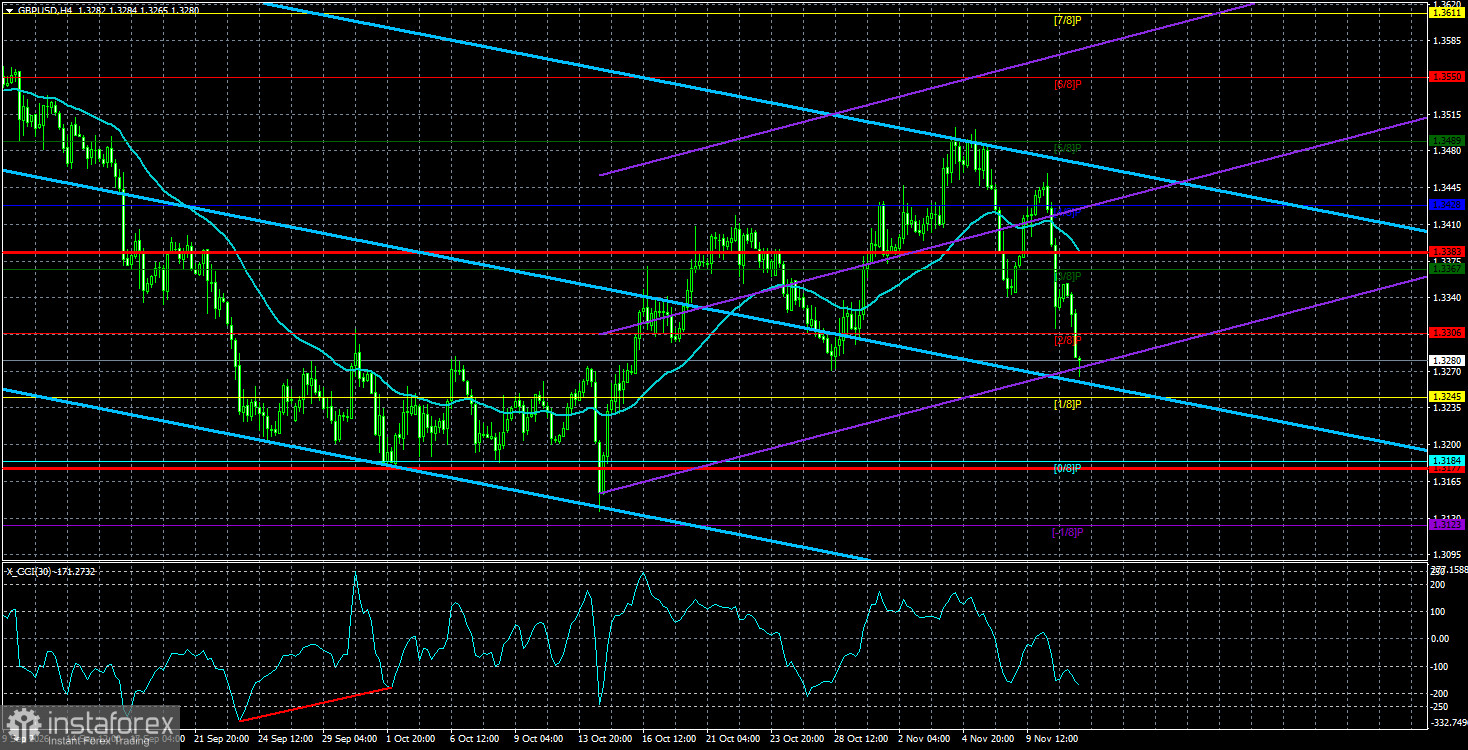
On Tuesday, currency markets again reached a fever pitch. Geopolitical tensions are cooling, unrest in the EU is easing, and it will be much harder for Donald Trump to pursue protectionist policies in the remaining two years of his presidency. Yet FX markets are in full emotional mode.
The trigger was Tuesday's US October CPI report. Even though annual figures were not published this time (last year's October data were affected by a government shutdown), the market sold euros and pounds aggressively — moves of roughly 100 and 150 pips respectively — based on the monthly inflation print. Although October's month-on-month inflation beat forecasts, it actually slowed from September's 0.6% print. In other words, inflation growth decelerated, yet the market reacted as if it had accelerated.
Remember: the US is not the only country experiencing inflation, and the Federal Reserve is not the only central bank tightening policy. So yes, the dollar had legitimate reasons to strengthen on Tuesday, but not to the exaggerated extent we saw — and clearly not without follow-through on Wednesday. The pound has traded largely logically through 2026 inside a sideways channel. Factors supporting the dollar were geopolitics and Fed policy expectations; factors supporting the pound include Bank of England tightening and lingering domestic positives in the UK. Last year sterling benefited from Trump's actions that pushed capital flows and a comparatively weaker dollar; that dynamic is now more mixed.
Tuesday also featured several Fed speakers. While we argued that central-bank speeches matter less when policy paths are well known, a single comment by Christopher Waller—that he might support a 50-bp hike in December—was enough to spark another wave of dollar buying. So the market keeps finding formal reasons to open new dollar longs even when the aggregate picture doesn't justify such strength.
Notably, no other FOMC member has backed a 50-bp December move, and FedWatch odds do not show traders believing in that scenario. The market expects a December hike and perhaps another in March, yet it is pricing more aggressive tightening (a 50-bp December move plus several hikes next year). We continue to view much of the dollar's recent strength as illogical. It's less obvious against the pound, but very visible against the euro.
Trading Recommendations EUR/USD:
The EUR/USD pair remains in a downtrend that currently lacks sufficient fundamental, macroeconomic, or geopolitical backing for continuation. The global fundamental backdrop for the dollar remains negative overall, but in 2026, geopolitics first and then the Fed's hawkish shift provided strong support for the US currency. When price is below the moving average, consider short positions with targets at 1.1047 and 1.1008. Above the moving average, long positions become relevant with targets at 1.1230 and 1.1292. However, before initiating directional trades, the pair needs to break out of the sideways channel 1.1114–1.1265.
Trading Recommendations GBP/USD:
The GBP/USD pair continues an uptrend that could become part of the broader 2022 global trend. Donald Trump's policies will continue to weigh on the US economy, so we do not expect sustained long-term dollar strength based solely on that. 2026 has been positive for the dollar so far because geopolitics and inflation forced capital into safe assets and prompted the Fed to resume policy tightening. On the weekly timeframe, price remains flat between 1.3150 and 1.3780 within a four-year uptrend, supporting expectations of sterling appreciation in the medium term. Consider long positions with targets of 1.3489 and 1.3523 when price is above the moving average. If price is below the moving average, look to trade the downside, targeting 1.3245 and 1.3184.
Explanations for the Illustrations:
- Linear-regression channels help identify the current trend. If both channels point in the same direction, the trend is strong.
- The moving average (settings 20,0, smoothed) indicates the short-term trend and the direction in which trading should be biased.
- Murray levels are used as targets for moves and corrections.
- Volatility levels (red lines) show the likely price channel the pair may trade within over the next 24 hours based on current volatility.
- The CCI indicator: readings into the oversold area (below -250) or overbought area (above +250) signal that a trend reversal is likely approaching.