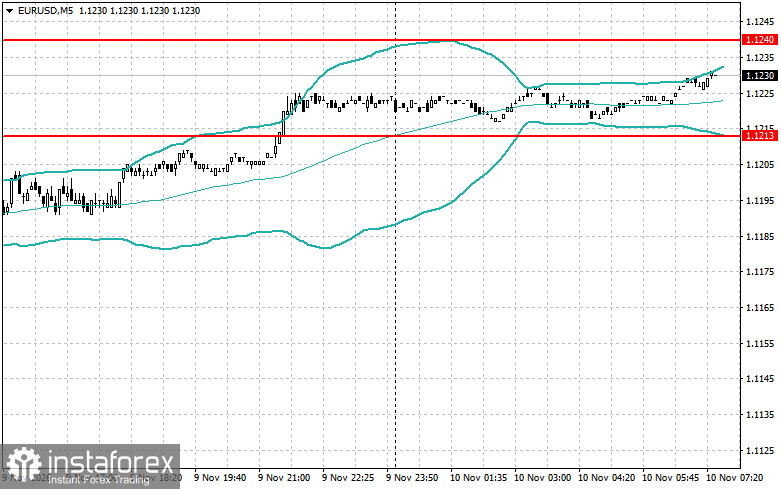
The EUR/USD pair is trading around 1.1229, well above Friday's low of approximately 1.1131, although it was still at 1.1161 on Monday morning. The upward movement has been gradual, without sharp moves, and appears to be driven by a weakening US dollar rather than by the euro's own strength.
Germany's foreign trade figures came in below expectations. The trade surplus, which represents the difference between the value of goods a country exports and imports, amounted to EUR 15.6 billion in September, compared with the expected EUR 18.1 billion. This is negative news for the euro, as Germany is considered the main driver of the region's economy, and its trade surplus has declined for the third consecutive month. It stood at EUR 21.3 billion in July and, following a revision, at EUR 17.8 billion in August. The Sentix Investor Confidence Index for November provided a slightly more positive signal, rising to 2.4 against a forecast of 1.8. However, the previous month's reading was higher at 2.7. Investors are less pessimistic than expected, but sentiment has not improved compared with October. Last week, retail sales added further pressure, falling by 0.7% in September, although a decline of just 0.1% had been expected. Consumers are cutting back on spending, while eurozone inflation reached 4.0% in October.
The ECB's position is relatively clear. The deposit rate, at which banks place their funds with the central bank, stands at 2.50%. On October 29, it was left unchanged following two rate hikes during the current cycle, in June and September. Christine Lagarde said at the time that the Governing Council had discussed a rate increase and that the direction of monetary policy was clear, provided no major shocks occurred. The market expects another increase to 2.75% at the December 17 meeting. This is more of a source of support for the euro than a driver of its growth, as the key decisions affecting the exchange rate are currently being made in the United States.
The US dollar is receiving support from both economic data and comments from policymakers. Last Friday, the US labor market report showed an increase of 165,000 jobs, compared with the expected 65,000, while the unemployment rate fell to 4.1%. Yesterday, wholesale inventories, which represent goods held in storage by wholesalers, increased by 0.7%, against a forecast of 0.6%. This figure is relatively minor in itself, but Federal Reserve officials Austan Goolsbee and Tom Barkin reiterated that inflation remains the main concern and indicated that a firm response could be necessary. Goolsbee had previously adopted a more cautious position, leaving both a rate increase and a pause on the table, so the tone has clearly become more hawkish. The Fed's current interest rate range is 3.75%–4.00%. On October 28, the rate was left unchanged, but the vote ended 10–2, with two committee members, Lisa Cook and Beth Hammack, calling for an increase. The market currently puts the probability of a rate hike at the December 9 meeting at approximately 80%. The gap between the Fed's rate and the ECB's 2.50% rate is attracting capital flows toward the dollar and remains the main obstacle to further euro appreciation.
US inflation data will be released today, making it the most important event of the day. The headline inflation rate stood at 3.7% year over year in September, while core inflation was 2.6%. Core inflation excludes energy and food prices, making it a useful indicator of whether inflationary pressures are becoming more widespread across the economy. The higher the figures, the more confidently the market will price in a December rate hike, strengthening the dollar. Softer readings, by contrast, would give the euro an opportunity to consolidate its rebound. Federal Reserve officials Christopher Waller and Bowman will speak following the data release. In early September, Waller said he was prepared to support keeping rates unchanged if inflation continued to decline, illustrating how quickly sentiment within the committee has shifted. Any comments following the release could easily amplify market movements, so it is better to avoid drawing conclusions too quickly during the first few minutes.
Momentum
The price is currently confined to a narrow range between 1.1218 and 1.1244. A move beyond either boundary is known as a breakout, but merely touching a level is not enough. Price consolidation beyond the boundary is required, meaning that several consecutive five-minute candles must close above or below it. Otherwise, there is a considerable risk of a false breakout, after which the price returns to its previous range.
The upper boundary is at 1.1244. If the pair consolidates above this level, the next targets will be 1.1272 and then 1.1298. Such a move would require a catalyst, with softer US inflation being the main potential trigger, as it would weaken the dollar. However, the interest rate differential and the hawkish tone adopted by Goolsbee and Barkin are both working against buyers, making this scenario less likely.
The lower reference level is 1.1218. Consolidation below it would open the way toward 1.1187 and then 1.1164. The price is currently just 11 points above this level, so a reaction could occur quickly. This is considered the primary scenario, as the euro's advance is not supported by economic data, while high US inflation could quickly restore demand for the dollar.
Mean Reversion
There are two levels to watch here: 1.1240 and 1.1213. Both are very close to the breakout boundaries, which calls for particular caution. The upper reference level at 1.1240 is just four points below 1.1244. If the price reaches this zone, fails to consolidate above it, and then moves lower, short positions can be considered. A stop-loss should be placed slightly above 1.1244, with an appropriate buffer. However, if the pair consolidates firmly above 1.1244, this would constitute a breakout, and selling at that point should be avoided. It is impossible to determine the nature of the move based on a single touch, and the difference between the two scenarios may become clear within just a few minutes. Therefore, it is better to stay out of the market during the initial reaction in this zone.
The lower reference level at 1.1213 is five points below 1.1218. The approach here is the reverse. The price first breaks below 1.1218, reaches 1.1213, fails to continue lower, and then moves back above the level. Only then should long positions be considered, with a stop-loss placed below 1.1213, allowing for an appropriate buffer. This pattern is most likely to emerge if US inflation comes in close to expectations and the market retraces after its initial reaction. However, if the data surprise the market and the price consolidates below 1.1213, the rebound scenario is invalidated, and the downside breakout scenario takes precedence.