Michael Saylor's Strategy bought an additional 1,036 Bitcoins for $81.9 million at an average price of $79,012, bringing its holdings to 850,364 BTC worth $63.6 billion. From these figures, it follows that Bitcoin is valued at roughly $74,800 — meaning the latest lot is already about 5% underwater versus the market. At the same time, the company repurchased $188 million of preferred shares (STRC), and its dollar reserve fell to $4.9 billion. Previously, in September, Strategy bought 4,603 BTC for $369.7 million at $80,318 when holdings were 845,050 BTC and the reserve was about $7 billion; Fong Le described the approach as a "two?way strategy." Since then, the purchase size has shrunk severalfold, the reserve has slimmed by roughly $2.1 billion, and the 4 October holdings (848,000 BTC at an average price of $75,440.70) now barely exceed that level.

This is a positive signal in terms of the gesture's size, but not in scale. By comparison, US spot Bitcoin ETFs lost $1.28 billion last week — so Strategy's buy covers only about 6% of that outflow. I believe the $188 million STRC buyback is more important than the Bitcoin purchase itself: it supports the preferred shares, which on November 4 returned to par of $100 for the first time since May, but it also uses funds that could otherwise have gone into BTC.
Bitmine, Tom Lee's firm, bought another 9,587 ETH over the past week, taking its holdings to 6.07 million tokens — about 4.97% of the total supply. Over the last six weeks, the company added roughly 450k ETH, and it has about 35k ETH left to reach its announced 5% target — roughly three to four weeks at the current pace. Tom Lee said purchases would stop after the target is reached, and that is the main risk for Ethereum: the single regular large buyer that was accumulating tokens into a falling market will exit the game.
Against this backdrop, Tom Lee expects a crypto bull market within the next 24–36 months. He views the prolonged stagnation in Ethereum more as investor impatience than a reflection of real prospects. On November 3, Tom Lee said the market was at the bottom, and that selling after the Binance hack was likely already over. Since then, Bitcoin slipped from $80,500 to $74,800, and Ethereum dropped from $2,433 to below $2,150, so the short?term forecast has not yet been confirmed.
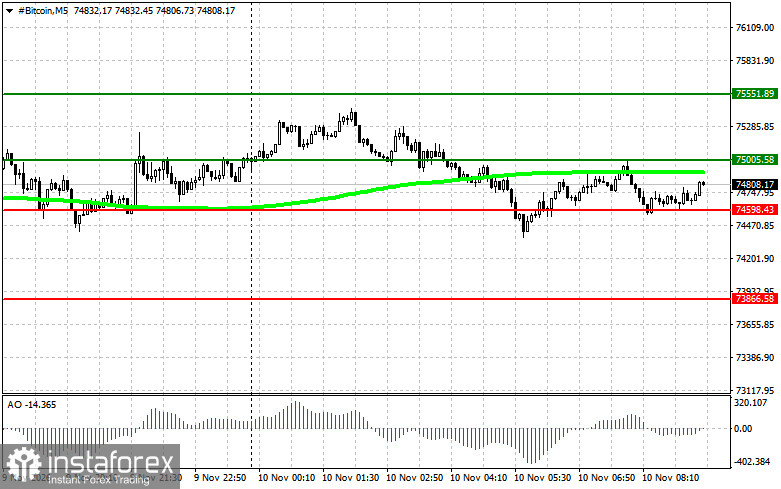
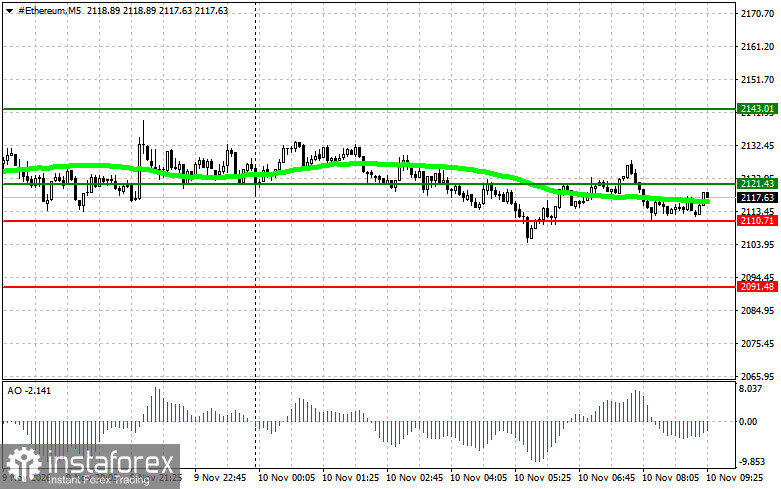
I do not rule out that until the US inflation data released today, Bitcoin will remain below $75,500 with a test of $73,800, and Ethereum below $2,143. Purchases by Strategy and Bitmine cushion the decline but do not change the trend, while ETFs continue losing hundreds of millions of dollars a week. When Bitmine reaches 5% and stops, Ethereum will lose a buyer, and Lee's bullish scenario will require a new purchaser — that is what to watch in the coming weeks.
Bitcoin
The nearest range runs between support at $74,600 and resistance at $75,000, and the trading plan is built around two mirrored directions with full breakout and bounce scenarios. Buys: a confident break above $75,000 opens the way to $75,500, where it makes sense to take profits and consider a short on the retracement; the condition is price above the 50?day moving average and the Awesome Oscillator above zero. If price falls below $74,600 but the downside break fails and buyers quickly reclaim the level, a buy is permissible targeting first $75,000 and then $75,500.
Sells are mirrored: a confirmed close below $74,600 gives a short targeting $73,800, provided the 50?day MA is above price and the Awesome Oscillator is below zero. If price rises to $75,000 but the breakout does not hold, consider a short back to $74,600 and then $73,800.
Ethereum
The logic fully mirrors Bitcoin on its own price scale: the working range is between support at $2,110 and resistance at $2,121. A breakout above $2,121 opens the way to $2,143, where it makes sense to take profits and consider a short on a retracement; the condition is price above the 50?day MA and Awesome above zero. If price falls below $2,110 but the drop is not confirmed, and buyers quickly reclaim the level, a buy is acceptable, targeting first $2,121 and then $2,143.
A sell is possible on a confirmed close below $2,110, targeting $2,090, provided the 50?day MA is above price, and the Awesome Oscillator is below zero. If price moves up to $2,121 but the breakout fails to hold, consider a short back to $2,110 and then $2,090. Both indicators are used only as filters to reject false moves, not as standalone entry signals; decisions should be made only after real price confirmation at the specified levels.